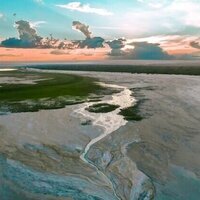



(CN) - Scientists studying geothermal springs in Zambia may have identified the early formation of a new tectonic plate boundary.
In a study published this week in the journal Frontiers in Earth Science, researchers reported unusually high helium isotope ratios in geothermal springs along Zambia's Kafue Rift, evidence they say points to an active continental rift.
The findings suggest the Southwest African Rift Zone - a vast network of fractures stretching roughly 1,550 miles from Tanzania to Namibia - may be undergoing the first stages of continental breakup. This multi-million year process can split landmasses and create new tectonic plates.
"This is the first time we have geochemical evidence that the mantle fluids are reaching the surface in this part of Africa," study co-author Ruta Karolyte of the University of Oxford said in an email. "If similar signatures are found along other parts of this 2500 km long zone, the case for an emerging plate boundary becomes very compelling."
Researchers have long suspected the Kafue Rift could represent an emerging fault system because of its landscape features and elevated geothermal activity. But confirming an active rift required solid evidence like molten material that had traveled upward from the mantle.
To investigate, scientists sampled gases from eight geothermal wells and hot springs across Zambia, including six located within the suspected rift zone.
The team analyzed isotopes, which are chemically identical versions of elements with different atomic masses, to determine where the gases originated. Helium isotopes are especially useful because mantle-derived helium contains much higher proportions of helium-3 than gases typically found in Earth's crust or atmosphere.
Samples taken from springs within the Kafue Rift showed helium isotope ratios similar to those measured in the East African Rift System, one of the world's best-known active continental rifts. Springs outside the rift zone did not show the same signature.
"The hot springs along the Kafue Rift of Zambia have helium isotope signatures which indicate that the springs have a direct connection with the Earth's mantle," study co-author Mike Daly of the University of Oxford said in a statement.
The researchers also found elevated levels of carbon dioxide consistent with gases originating from deep mantle fluids. The findings suggest the rift has fractured through the crust enough for mantle material to migrate toward the surface, a hallmark of active tectonic stretching.
"A rift may become a plate boundary," Daly said, although he noted in the statement that many rifts eventually stop developing before continents fully split apart.
However, weaknesses embedded within the region's ancient crust appear favorably aligned with stresses generated by surrounding mid-ocean ridges. This means the amount of force needed for the continent to fracture may be potentially lower.
The discovery could have economic as well as geological significance. Early-stage rifts could create more favorable conditions for geothermal energy development. The relatively early stage of the Kafue Rift system may also make those resources easier to access, researchers said.
However, the researchers caution that this research is only an early snapshot of a massive rift system that extends expansively across southern Africa.
Source: Courthouse News Service